Wednesday, 26 April 2017

Take two paracetamol...Really mom?....(By Delra Morgan)


On December 22nd it was my last day of exams at college and thought it was a day of relief for me. heading home form school, I was so excited because school is closed and its was time to prepare for the Christmas holidays. upon arrival to my home that night, I felt the need to void so i went straight to the washroom. whilst voiding there was this burning sensation which seem to be a bit painful; but i took this for nothing because since i was holding in urine for a while now i simply thought this was the cause off the pain.


Image result for female urinary tract infection

what is happening to me????......As the days passed by I ignored the pain...but it only seemed to get worst. I started getting severe, intense abdominal pain.especially at nights having me not being able to sleep for two nights a mild fever and I also had a frequent urge to void but not actually doing it.The pain was so unbearable i couldn't stand it any longer. But presently in these day since you have pain leave it in the hand of paracetamol. I complained to my mother of my condition, of the intense pain i was getting but unfortunately, "go drink paracetamol" she said. yes i ran along and drank them but these painkillers did nothing for me.
Image result for urinary tract infection
Am i going to die?....seeing that i could bear the pain any longer i went to the nurse and explained to her my symptoms. I was shocked when i was told that i have a UTI because i did not know what that was. A (UTI) Urinary Tract Infection is an infection of any part of the urinary tract caused by a microbe such as bacteria. UTIs have different names depending on which part of the urinary system is infected.

  • bladder infection- cystitis 
  • kidney infection- nephritis
  • urethra infection-urethritis
But i had urethritis. The pain and the strong urge to void are the exact symptoms of this infection "The pain was more intense at night when the body is a rest  because the bacteria tend to be more active" the nurse said. Another symptom of this infection is having a cloudy, bloody or a strong smelling urine. this symptom occurs if the bacteria moved up to the bladder and or kidneys, but luckily i didn't have it. It is said that women are more likely to develop UTIs than men due to the anatomical differences. the female urethra ids shouter than that of the male, and is closer to the anus making it more likely for bacteria to be transferred from that area to the urethra. There are other factors which may increase the likelihood of developing a UTI. Theses may include:poor personal hygiene,bowel incontinence, use of spermicides etc.

Image result for drinking water

However this can be treated by drinking a lot of water. Water flushes out the infection.also antibiotics can be given for the bacteria.

Female Reproductive System. Julie Bonnie

Female Reproductive System


The female reproductive system includes the ovaries, fallopian tubes, uterus, vagina, vulva, mammary glands and breasts. These organs are involved in the production and transportation of gametes and the production of sex hormones. The female reproductive system also facilitates the fertilization of ova by sperm and supports the development of offspring during pregnancy and infancy.

The female reproductive anatomy includes both external and internal structures.The external female genitalia is also referred to as the vulva. It is made up of different organs, the most important ones being the mons pubis, both the labia majora and the labia minora , the vaginal opening, urethral opening (from where urine is dispensed), and the clitoris.


Mons pubis/pubic mound: is pubic bone that provides cushioning to the vulva.
a raised layer of adipose tissue between the skin and the

Labia majora: enclose and protect the other external reproductive organs. During puberty, hair growth occurs and the skin of the labia majora, which also contain sweat and oil-secreting glands.

Labia minora: can have a variety of sizes and shapes. They lie just inside the labia majora, and surround the openings to the vagina and urethra. This skin is very delicate and can become easily irritated and swollen.  

Bartholin’s glands: These glands are located next to the vaginal opening on each side and produce a fluid (mucus) secretion.  

Clitoris: The two labia minora meet at the clitoris, a small, sensitive protrusion that is comparable to the penis in males. The clitoris is covered by a fold of skin, called the prepuce, which is similar to the foreskin at the end of the penis. 

The internal reproductive organs include: 


Vagina: The vagina is a canal that joins the cervix to the outside of the body. It also is known as the birth canal. The cervix is a narrow, lower portion of the reproductive system that connects the vagina and uterus. Your cervix is what dilates during labor, and it also thins (called effacement) to allow the baby to pass through. In addition to the cervix and the vagina, the internal female anatomy also comprises the uterus. 

Uterus (womb): The uterus is a hollow, pear-shaped organ that is the home to a developing fetus. The uterus is divided into two parts: the cervix and the main body of the uterus, called the corpus. The corpus can easily expand to hold a developing baby. A canal through the cervix allows sperm to enter and menstrual blood to exit

Ovaries: The ovaries are small, oval-shaped glands that are located on either side of the uterus. The ovaries produce eggs and hormones. When a woman starts menstruating, the ovaries release eggs on a monthly basis (ovulation) until menopause.

Fallopian tubes: These are narrow tubes that are attached to the upper part of the uterus and serve as pathways for the ova (egg cells) to travel from the ovaries to the uterus. Fertilization of an egg by a sperm normally occurs in the fallopian tubes. The fertilized egg then moves to the uterus, where it implants to the uterine lining.


The female reproductive cycle 


The female reproductive cycle is the process of producing an ovum and readying the uterus to receive a fertilized ovum to begin pregnancy. If an ovum is produced but not fertilized and implanted in the uterine wall, the reproductive cycle resets itself through menstruation. The entire reproductive cycle takes about 28 days on average, but may be as short as 24 days or as long as 36 days for some women.

Under the influence of follicle stimulating hormone (FSH), and luteinizing hormone (LH), the ovaries produce a mature ovum in a process known as ovulation. By about 14 days into the reproductive cycle, an oocyte reaches maturity and is released as an ovum. Although the ovaries begin to mature many oocytes each month, usually only one ovum per cycle is released.


Once the mature ovum is released from the ovary, the fimbriae catch the egg and direct it down the fallopian tube to the uterus. It takes about a week for the ovum to travel to the uterus. If sperm are able to reach and penetrate the ovum, the ovum becomes a fertilized zygote containing a full complement of DNA. After a two-week period of rapid cell division known as the germinal period of development, the zygote forms an embryo. The embryo will then implant itself into the uterine wall and develop there during pregnancy.


While the ovum matures and travels through the fallopian tube, the endometrium grows and develops in preparation for the embryo. If the ovum is not fertilized in time or if it fails to implant into the endometrium, the arteries of the uterus constrict to cut off blood flow to the endometrium. The lack of blood flow causes cell death in the endometrium and the eventual shedding of tissue in a process known as menstruation. In a normal menstrual cycle, this shedding begins around day 28 and continues into the first few days of the new reproductive cycle.


If the ovum is fertilized by a sperm cell, the fertilized embryo will implant itself into the endometrium and begin to form an amniotic cavity, umbilical cord, and placenta. For the first 8 weeks, the embryo will develop almost all of the tissues and organs present in the adult before entering the fetal period of development during weeks 9 through 38. During the fetal period, the fetus grows larger and more complex until it is ready to be born.


Lactation is the production and release of milk to feed an infant. The production of milk begins prior to birth under the control of the hormone prolactin. Prolactin is produced in response to the suckling of an infant on the nipple, so milk is produced as long as active breastfeeding occurs. As soon as an infant is weaned, prolactin and milk production end soon after. The release of milk by the nipples is known as the “milk-letdown reflex” and is controlled by the hormone oxytocin. Oxytocin is also produced in response to infant suckling so that milk is only released when an infant is actively feeding. 


The breasts are specialized organs of the female body that contain mammary glands, milk ducts, and adipose tissue. In the center of each breast is a highly pigmented nipple that releases milk when stimulated. The areola, a thickened, highly pigmented band of skin that surrounds the nipple, protects the underlying tissues during breastfeeding. The mammary glands are a special type of sudoriferous glands that have been modified to produce milk to feed infants. Within each breast, 15 to 20 clusters of mammary glands become active during pregnancy and remain active until milk is no longer needed. The milk passes through milk ducts on its way to the nipple, where it exits the body.


Reference

http://www.innerbody.com/image/repfov.html#full-description
https://www.avawomen.com/avaworld/the-female-reproductive-system/ 
http://babypradise.blogspot.com/2015/03/stages-of-fetal-growth.html

Friday, 21 April 2017

Hormonal Contraceptives (The Pill/s) by Norma Benjamin


I was recently engaged in a discussion with two of my pageant sisters about hormonal contraceptives; birth control/family planning pill and the morning after pill/Emergency contraceptive (Plan B). 

They both contain hormones to change the way the body works and prevent pregnancy but the family planning pill will not allow a fertilized egg to implant while the emergency contraceptive kill an implanted egg. In this case hormones in the pill control the ovaries and the uterus; hormonal birth control prevents the egg from being released from the ovaries, thicken the cervical mucus to prevent sperm from entering the uterus and thinning the lining of the uterus; making it hard for the egg to stick, to prevent pregnancy.   


WhatsApp Image 2017-03-14 at 9.07.04 PM.jpeg
To understand how hormonal contraceptives works we have to understand how the menstrual cycle works. The 28 day cycle with day one being the day your period starts and day 14 being ovulation day. A typical cycle is approximately 24 to 35 days and the average 28 days for most women. Hormones include from the pituitary gland in the brain - the follicle stimulating hormone (FSH) and the luteinizing hormone (LH) and from the ovaries estrogen and progesterone. The main hormones that affect the female reproductive organs is estrogen and progesterone. 

On Day 1 of the menstrual cycle, estrogen and progesterone levels are low. Low levels of estrogen and progesterone signal the pituitary gland in the brain to produce Follicle Stimulating Hormone (FSH). In the first half, FSH hormone stimulate the follicle in the ovary to mature and ready to release an egg to ovulate around day 14. The follicle produces more estrogen to prepare the uterus for pregnancy. At ovulation, there is an LH surge which results in the release of an egg from the follicle. ( around the 14th day). If the egg is not fertilized, estrogen and progesterone levels drop and on day 28 the menses begin. 

The Birth Control Pill, aside from being contraceptive, fundamentally changes how a woman’s body was made to function. It basically tricks her body into thinking it is constantly pregnant. The family planning pill contains both estrogen and progestin while emergency pill contains only progestin.What happens is that estrogen and progesterone stabilize a woman's natural hormone levels and prevent estrogen from peaking mid cycle. Without estrogen bump, the pituitary gland does not release hormones that normally cause ovaries to release a mature egg. Constant estrogen levels present causes FSH to be down due to the negative feedback (no follicular development for ovulation). So basically estrogen stops the pituitary gland from producing FSH and LH (decrease in) in order to prevent ovulation. Now progesterone levels present causes LH to never surge due to the negative feedback and stops the pituitary gland from producing LH in order to prevent egg release. It also makes the uterus lining inhospitable to fertilize an egg, partially limit the sperm ability to fertilize an egg and thicken the cervical mucus to hinder sperm movement.  

Weight gain is a controversial side effect argued. *especially in Dominica* Clinical study have found no consistent association between birth control and weight gain. However estrogen influences insulin resistance; causing the insulin in your body to make more because the cells get somewhat numb to the insulin.  So more insulin is needed because fat cells to grow. I have a friend who recently started birth control and she experienced some weight gain as well as rapid weight loss when she made the decision to stop the pill. So maybe birth control and weight gain are somewhat linked for some people. 

To conclude, as teenagers we constantly think of the future ahead of us and when engaged in a relationship, the topic of starting contraceptives may come up. Starting it is all about choice and for the females you may feel like a walking baby machine but you're not. To make this decision one needs to understand that this affects the natural functioning of your body. Your choice of contraception is most certainly a personal one. And in a world full of modern medical technology, we have been taught that taking a pill is the answer to any health problem. However, unnatural choices have unnatural consequences.

Wednesday, 19 April 2017

AIR GOES IN AIR COMES OUT, HOW DIFFICULT COULD THAT BE?


It started with a reoccurring shortness of breath (dyspnoea) and a nasty occasional cough.  She had also notice it had become a difficult task for her to complete her daily exercises because it was difficult for her to breathe.  Jenny obviously pushed it away until it got worse.  On conducting her own research, she found a disease called emphysema which entailed some of her symptoms.  The cough was as result of mucus production and she then realised she had another symptom she did not even realised "pursed-lip breathing."  To empty trapped air the individual would purse their lips, leaving only a small opening. Then upon exhaling, the lips cause obstruction of the flow of air, increasing pressure in the collapsed airways, and opening them, allowing the trapped air to empty.
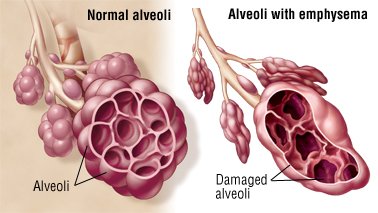
Image result for emphysema animation
She then decided it was time for a check-up.  At her doctor’s office, it was concluded that she had a "barrel chest," which was common in people with emphysema.  The distance from the chest to the back becomes more pronounced. This is a result of air becoming trapped behind obstructed airways.
Emphysema symptoms:
  • Wheezing
  • Coughing
  • Tightness feeling in the chest
  • Barrel-like distended chest
  • Constant fatigue
  • Difficulty sleeping
  • Morning headaches
  • Weight loss
  • ankle swelling
  • difficulty concentrating
Emphysema/obstructive lung disease is a long-term, progressive disease of the air sacs found in the lungs it is due to over-inflation of the alveoli.  The alveoli walls are destroyed, this is a dangerous disease because the alveoli tissue is involved in exchange of gases (oxygen and carbon dioxide).  It produces abnormally big air spaces that will remain filled with air even during exhalation.
Emphysema
Emphysema is part of the disease COPD/Chronic Obstructive Pulmonary Disease with chronic bronchitis.  Chronic Bronchitis is inflammation of the bronchial tubes which creates mucus.  These two diseases usually occur together.
What could have been the cause of this disease she though not aware that her father’s cigarette habit had caught up with her. This disease can be caused by smoking either second-hand or first-  hand, pollution, exposure to dust or fumes.  A small number of people develop emphysema from the disease alpha 1-antitrpsin deficiency which is an inherited disease. 

 Sadly emphysema can not be cured but treatment can be used to lessen symptoms. 
Medication
  • A bronchodilator may be suggested by a doctor depending on the severity of the disease. It can be used to help relieve coughing, shortness of breath and breathing problems by relaxing constricted airways.
  • Inhaled steriods which may help relieve shortness of breath. 
  • Antibiotics help if you develop a bacterial infection. 
Therapy

  • Pulmonary rehabilitation are breathing exercises and techniques that may help reduce your breathlessness and improve your ability to exercise.
  • Nutrition therapy provides proper nutrition usually doen in early stages of emphysema.  many people need to lose weight, while people with late-stage emphysema often need to gain weight.
  • Supplemental oxygen done usually in severe case isIthe use of oxygen regularly at home.
Surgery
  • Lung volume reduction surgery in this procedure done to get rid damaged lung tissue which improves breathing.
  • Lung transplant is an option when all has failed.

Resources
http://www.mayoclinic.org/diseases-conditions/emphysema/basics/treatment/con-20014218


Tuesday, 18 April 2017

Fire.....Liquid and the Toilet????????? by Renee Harry

Imagine going to the bathroom and contemplating " Should I releive myself and go through the burn which mimics the firey pits of hell?" or "Should I hold it in and risk more unknwn consequences?
Last year June I was admitted to the Princess Margret Hospitl with the far that I was suffering from apendicitis. The pain and the uncontrolable fever was getting out of hand and serious enough to call the ambulance and admit me to the hospital. The year before that in 2015 I was diagnosed with Polysistic Ovarian Syndrome so I brushed of the pain as in relation to that. The both times I was admitted to the hospital I gained a new friend "Mrs Urinary Tract Infection". During those sick days were the only time I looked at the toilet with fear, and the first time I looked at a non human object "coupay yeux". Urinating was a complete and utter disaster from start to finish. All that came to mind was "shaleh shaleh shaleh shalleeehhhh!!!!"


 U.T.Is are a bacterial infection where  microbes fom the gastrointestinal tract
cultivates the urinary tract and cause infection.
The bacterias reponisble for this infection are

  •  E.coli which is the bacteria found in the GI with a whopping 80% causative percentage 
  • Staphylococcus Saprophyticus
  • Pseudomonas Aeruginosa
  • Klebsiella Pneumonia

There are three (3) types of U.T.Is
  1. Urethritis: which is inflammation of the urethra
  2. Cystitis : inflammation of the bladder
  3. Nephritis: inflammation of the kidneys which is the most dangerous of all and if not treated can lead to kidney failure


Signs and Symptoms
The infection normally begins at the opening of the urethra where urine leaves the body and moves upward into the urinary tract. The signs and symptoms may vary according to the location of the infection in the urinary tract.

Location of Infection                                  Signs and Symptoms

Urethra (Urethritis)                          -Burning sensation when urinating  
                                                              -Discharge

Bladder (Cystitist)                             -Pelvic pressure
                                                              -Lower abdomen discomfort
                                                              -Frequent painful urination
                                                              -Blood in urine

Kidneys (Nephritis)                          -Upper  back and side pain
                                                              -High fever
                                                              -Shaking and chills
                                                              -Nausea
                                                              -Vomiting

 Causes


U.T.Is have many causes but women are more prone to the infection because their urethras are shorter compared to men. One of the functions of urine is to flush out the urethra but if there is too much bacteria , urination may no stop the spread.
Some of the causes includes:

  • Sexual Intercourse                        (Females)

                                      Women who are sexually active are at greater risk of getting the infection compare to women who are not and also having multiple sexual partners increases the risk.

  • Types of birth control:
                                          - The use of spermicides altercates the delicate balance of the vagina by introducing foreign chemicals 
                                           - The use of diaphrams also increases the risk
  • Low levels of estrogen:
                                            After menopause the level of circulating estrogen in the body decreases which causes changes to the urinary tract and causes you to be more volnerable to U.T.Is
  • Immune Suppression:
                                          Diseases such as diabetes melitus and HIV impairs the immune system and causes the response time to infections to be slowed down which causes people to be more suseptible to the infection.

  • Pregnancy:
                                          -The bladder and the urethra is pressed upon during pregnancy while the uterus grows and can cause incomplete emptying of urine, stagnant urine may be the cause

                                          -Pregnancy hormones causes changes in the urinary tract which causes nfections.

  • Enlarged Prostate:                       (Males)     
                                           Prostatitis or the blockage of the urethra can cause the incomplete emptying of the bladder which increases the risk of infection.


Treatment
Antibiotics are the first "go to" medication for urinary tract infections. The length of time on the medication and the type of medication prescribed depends on the the type of bacteria found in the urine and the persons overall health condition.
Drugs commonly used are:
  • Trimethoprim/ sulfamethoxazole (Bacteria, Septra, others)
  • Fosfomyin (Monurol)
  • Nitrofurantoin (Macrodantin)
  • Ciprofloxacin (Cipro)
  • Levofloxacin (Levaquin)
  • Cephalexin (Keflex)
  • Ceftriaxone (Rocephin)
  • Azithromycin (Zithromax, Zmax)
  • Doxycycline (Monodox, Vibramycin, others)
After a few days the symptoms usually clear up. However the treatment needs to be continued for a week or more. For first time appearing U.T.Is in otherwise healthy persons a shorter tresatment time is needed. The doctor will prescribe antibiotics for two to three days. For sever U.T.Is, the person may need treatment with intravenous antibiotics at the hospital.

Scientists used to think that cranberries protect against U.T.Is by making the urine more acidic which certain bacteria such as E.Coli will not grow. Now researchers ave a new theory that the cranberries make it hard for the bacteria to stick to urinary tract walls. Or it could be the nutrients in the cranberry causes a slippery linning of the urinary tract so the bacteria wont stick to it.

Prevention


These preventative measure can be followed to reduce the risk of getting a urinary tract infection.
  1. Drink lots of fluids especially water (the recommended 8 glasses per day). This dilutes the urine and causes frequent urination.
  2. Avoid foods and drinks that irritates the bladder like coffee, alcohol and spicy foods.
  3. Whipe from front to back. This minimizes the chance of bacteria from being intoduced in the vagina and urethra.
  4. Empty the bladder after intercourse. Urine flushes away bacteria that might have been moved to the urethra.
  5. Change birth control measures. Diaphrams and spermicides are a "no go"
  6. Take showers instead of baths, however if you decide on taking a bath make it short.
  7. Use tamponds for periods. Tamponds keep the bladder opening area drier compaired to sanitary napkins which limits bacterial growth.
  8. Do not wear tight fitting undergarments made of non-breathable fabric. Cotton underwear is advised.
  9. Men should have anual visits to the doctor for a digital rectal exam.


Thursday, 13 April 2017

Smell, Smell, where have my Smell Receptors gone!!! (By Lian Paul)

 *(Singing Voice)* Ohh where, Ohh where have my smell receptors gone…Ohh where OOhh where have they gone.

While doing the Respiratory System in our Anatomy and Physiology class, we came across the Nose being one of the main entrances for taking in air and then the mouth. We’ve learnt from our teacher that there are persons in the world today who can lost their sense of smell caused by an olfactory disease, in these case my mind set was based on how do persons go from having a sense of smell to not being able to and what possibly is the point of this disease.
There are many types disorders/disease of the smell receptors. Our smell receptors are also known as our Olfactory Receptors. 

And YES! These receptors could go bad to the point where we smell nothing at all. One’s sense of smell is controlled by a specific process. First off, a molecule released from a substance for e.g. A fragrance from a flower, must stimulate special nerve cells which are called olfactory cells that, are found high up in the nose. These nerve cells then send information to the brain where the specific smell is identified. Anything that interferes with these processes, such as nasal congestion, nasal blockage, or damage to the nerve cells themselves, can lead to the loss of smell.


Anosmia is a type of olfactory disorder, where there is a permanent or temporary loss of the ability to perceive smell/odour, or a lack of functioning olfaction cells. Anosmia is caused by inflammatory changes in the nasal passageways and this is simply treated by reducing inflammation, if it’s only a temporary loss of smell. Nasal congestion from a cold, allergy, sinus infections, or poor air quality is the most common cause of anosmia. While most of us take our sense of smell for granted, there are individuals who are wishing they still had their sense of smell. Have you ever thought about what it would be like no being able to smell? The loss of smell affects our taste and we all have experience temporary anosmia when we come into contact with a common cold, the flu, allergic reactions or during the irritation of our sinus.

To avoid the loss of our smell receptors we have to be careful as to what pesticides, or even different chemicals that we may come into contact with. The use of cocaine my also cause a lost in these receptors especially when it is used by inhalation, these drugs should not be taken so the loss of these smell receptors can be prevented. Temporary anosmia is very rear but different practices can cause it to occur.